

Why Is My Hair Thinning?
Why Is My Hair Thinning?
Everyone loses hair from time to time. It could happen during your morning shower, while you’re blowing it dry, or when you give it a quick brush—and that’s totally normal. But when you start to notice an excessive amount of hair thinning, bald patches, or your hairline starts to recede in places it didn’t before, you may start to wonder what’s up. On average, we lose 50 to 100 hairs a day, that’s just hair going through its cycles, and there will be a new one to replace it.
Don’t assume you’re the only one going through this. Hair loss is extremely common. So, why is your hair falling out? Here are some common causes of hair loss.
1. Telogen effluvium
Telogen effluvium is a temporary condition that can occur after pregnancy, major surgery, drastic weight loss, an illness (yes, including COVID-19 hair loss), or extreme stress, in which you shed large amounts of hair every day, usually when shampooing, styling, or brushing. During telogen effluvium, hair shifts faster than usual from its growing phase into the “resting” phase before moving quickly into the shedding (or telogen) phase. High-stress environments prevent the body from giving hair the TLC that it needs, causing hair to shed and fall out. Women with telogen effluvium typically notice hair loss six weeks to three months after a stressful event. At its peak, you may lose handfuls of hair.
2. Hereditary hair loss
Genetic hair loss or thinning is known as androgenetic alopecia and is the most common cause of hair loss, according to the American Academy of Dermatology. The gene can be inherited from either your mother’s or father’s side of the family, though you’re more likely to have it if both of your parents had hair loss.
Women are often protected from genetic balding because the low testosterone levels and higher estrogen in their bodies can protect hair. However, this can change during menopause (more on that later) and some women with strong family histories of hair thinning or balding may still experience this.
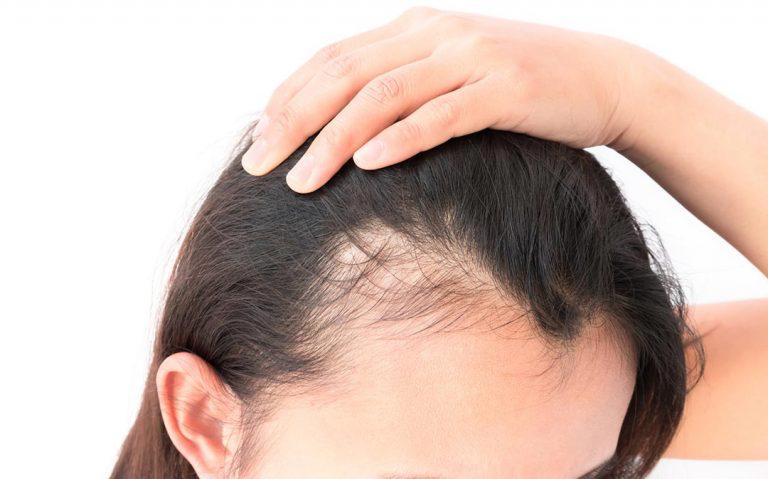
The condition develops slowly and may start as early as your 20s, and women with this trait tend to develop thinning at the hairline behind the bang area. Another red flag is a widening part, and the hair loss may be diffused, meaning it’s spread across the entire scalp. Your dermatologist or doctor can examine the pattern of hair loss and perform blood work to rule out other causes.
3. Alopecia Areata
Alopecia areata is an autoimmune disease in which the immune system attacks hair follicles. It may affect up to 7 million people in the United States and occurs in all genders, ages, and ethnicities. The cause is unknown, but it may be triggered by stress or illness. This is diagnosed by observing the pattern of hair loss or blood tests.
The condition can occur in three forms. Alopecia areata commonly causes round, smooth patches of baldness on the scalp, eyebrows, or legs. Total hair loss on the head is known as alopecia totalis, while hair loss that occurs all over the body is called alopecia universalis. Some people have reported that before the bald spot occurred, they felt something in that area—a tingling or an irritation.
4. Traction Alopecia
Traction alopecia is a form of hair loss that happens as the result of tight or heavy hairstyles. It forcefully pulls hairs out of the scalp. This causes inflammation in the hair follicle that ultimately leads to scarring and destruction of the hair follicle. It’s very commonly seen in people of African descent that wear tight hairstyles like braids, weaves, and even dreadlocks. Braids and weaves put direction tension on the scalp and hair follicles. But anyone can experience traction alopecia. Regularly wearing tight ponytails, buns, and braiding long thick hair are causes as well.
Signs of traction alopecia are scaling and flaking along the hairline, along with what appears to be small bumps around the hair follicle, which are the result of inflammation around the hairline. There can also be scalp tenderness. If caught early enough, the hair should grow back. But left untreated it won't grow back at all. A doctor's examination or biopsy can help differentiate this from other types of alopecia.
5. Medication side effects
Certain medications, like some cholesterol-lowering drugs, blood pressure drugs, warfarin (an anticoagulant), anti-seizure medication, anti-arrhythmia and weight-loss drugs all have hair loss as a potential side effect. If you notice you are starting to lose your hair three months or so after beginning a new medication, talk to your doctor about what your options are.
6. Thyroid Problems
Thyroid problems are common in women, especially over the age of 50. In fact, one in eight women will develop a thyroid disorder in her lifetime, according to the American Thyroid Association.
Your thyroid (the small, butterfly-shaped gland that sits at the base of your neck) is responsible for producing thyroid hormone, which is responsible for everything from your basal metabolic rate (the rate at which your body uses oxygen and energy to function) to the growth of your hair, skin, and nails. But when you don’t have the right amount, you may notice changes in bodily functions. When too little is pumped out, you are said to have hypothyroidism, or an underactive thyroid. If your body makes too much of the hormone, you’re said to have hyperthyroidism, or an overactive thyroid.
In addition to hair loss, hypothyroidism (too little hormone) may cause a host of symptoms, including unexplained weight gain, fatigue, constipation, depression, and difficulty concentrating. Hair, nails, and skin may become more brittle and break more easily. Hyperthyroidism (too much hormone) is less common than hypothyroidism but may cause inexplicable weight loss, heart palpitations, nervousness, irritability, diarrhea, moist skin, and muscle weakness. Both too much or too little thyroid hormone can affect your hair follicles, resulting in hair loss. Your doctor can check your thyroid levels with a blood test.
7. Iron deficiency anemia
An iron deficiency seems like an unusual reason for hair loss, but people can absolutely have hair loss while struggling with this. Women who have heavy periods or don’t eat enough iron-rich foods may be prone to iron deficiency, in which your body doesn’t create enough hemoglobin, a protein that transports oxygen to the tissues in your body. In turn, your red blood cell count drops quickly, zapping your energy. Nearly 30% of people in the United States are iron deficient and it’s more common in women than men.
Iron deficiency anemia causes extreme fatigue, weakness, and pale skin. You may have difficulty concentrating and also notice headaches, or cold hands and feet. Any type of exertion may leave you short of breath. Your hair may also start to thin and fall out. A doctor can perform a blood test to determine if you have iron-deficiency anemia and do a red blood cell count.
8. Polycystic ovary syndrome
As many as six million women in the United States suffer from polycystic ovary syndrome (PCOS). The condition, which can begin as early as age 11, is caused by a hormonal imbalance in which the ovaries produce too many male hormones. PCOS can cause facial hair growth, irregular periods, acne, and cysts on the ovaries. And while you may experience hair loss on your scalp, you may notice more hair elsewhere on the body. A doctor can take a blood test to look for elevated levels of testosterone and DHEAS (dehydroepiandrosterone), a product of testosterone.
9. Psoriasis, dandruff, and other skin conditions of the scalp
An unhealthy scalp can cause inflammation, and if the inflammation is deep in the scalp, it can cause hair loss. Skin conditions that lead to hair loss include seborrheic dermatitis (dandruff), psoriasis, and fungal infections such as ringworm. Seborrheic dermatitis causes the scalp to shed its skin, so you’ll notice greasy, yellowish scales on your shoulders or in your hair. It may be the result of yeast called Malassezia, hormonal changes, or excess oil in the skin. Scalp psoriasis, an autoimmune condition that causes excessive skin cell turnover, produces a very thick white scale that can bleed if pulled off. With ringworm, a fungus you contract by touching an infected person or animal, you’ll notice red patches on your scalp, which may be diffused. A physical examination by a dermatologist can determine which specific condition you have.
10. Menopause
Menopause is a normal condition that affects women as they age. By definition, menopause is a point in time 12 months after a woman’s last period. During this time, your body produces less estrogen and progesterone hormones. When women go through menopause, they lose the hair protection estrogen once offered. When the relationship between estrogen and testosterone changes, a condition called age-related hair thinning can occur. This happens in mostly post-menopausal women, but some men can experience it as well if their hormone levels change with age.
Everyone experiences different menopause symptoms, but you may notice symptoms like hot flashes, trouble sleeping, moodiness, irritability, pain during sex, and depression. Hair loss can also be an issue. During menopause, hair loss occurs because of the changes in hormones. When estrogen and progesterone drop, the result is a slow down of hair growth and a thinning of hair in many women. Your doctor may suggest a blood test to check your follicle-stimulating hormone and estradiol levels to rule out any other causes for the changes you’re going through.
11. Dramatic Weight Loss
Studies have shown that rapid or significant weight loss can trigger hair loss. This is commonly due to the deprivation of certain nutrients, including protein. You’ll notice if you start to lose weight quickly (typically defined as losing more than 5 percent of your weight in six months to a year) then hair loss can come on suddenly.
12. Vitamin D Deficiency
You often hear about vitamin D deficiencies in the winter months, especially in darker climates, because the vitamin mostly comes from sun exposure. But a lack of vitamin D can actually cause some hair loss and has been linked to genetic hair loss and alopecia areata. The good news is that it’s reversible when levels get back to normal. Your doctor can check your vitamin D levels through a blood test.